

Visualizing specific distances can be surprisingly difficult when you are standing on the ground, as our depth perception often fails us once an object exceeds the length of a standard room or a short hallway. When you ask yourself how far 500 feet actually is, you are essentially trying to bridge the gap between abstract numbers and physical reality.
This distance is roughly one-tenth of a mile, a measurement that often feels manageable on a map but can seem much longer when you are looking across an open field or down a city block. By breaking this length down into familiar objects and relatable human experiences, we can turn an invisible measurement into a tangible mental image that helps you navigate urban environments, sports fields, and outdoor spaces with greater accuracy.
Understanding the Math Behind the Measurement
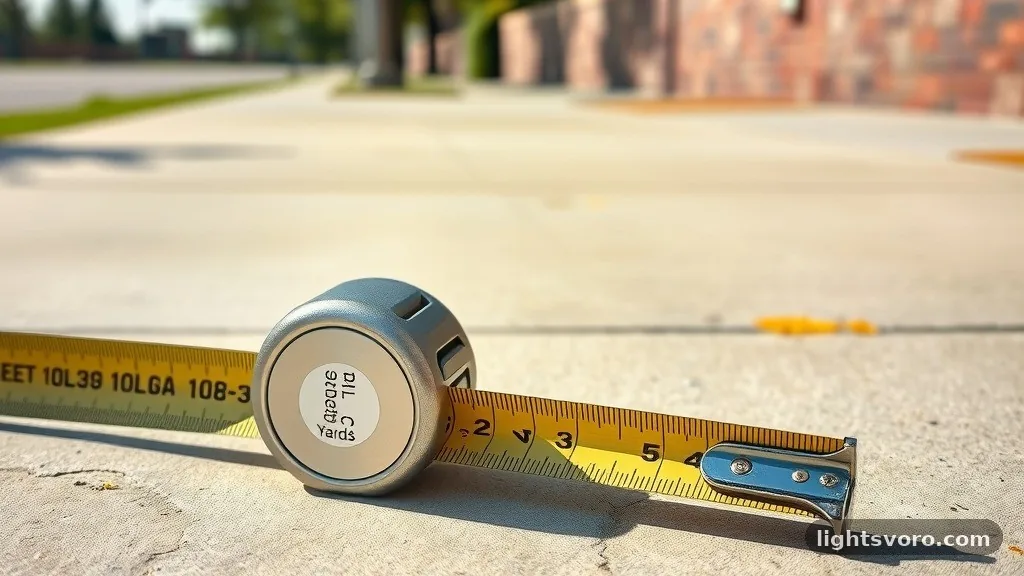
To wrap your head around 500 feet, it is helpful to look at how it relates to common units of measurement like the foot, yards, and miles. A single foot is a standardized unit of length, and because there are 5,280 feet in one mile, 500 feet represents a significant fraction of that total. Specifically, 500 feet is approximately 0.095 miles, which means it is just shy of being one-tenth of a mile.
If you are more comfortable thinking in yards, you can divide by three, which gives you roughly 166.6 yards. This mathematical breakdown is the foundation for all visual comparisons because it reminds us that while 500 feet is not a vast, sprawling distance that requires a vehicle to traverse, it is certainly long enough to make a brisk walk feel like a deliberate journey.
When you think about the feet inches conversion, it is easy to lose track of the scale. 500 feet is 6,000 inches, a number so large it becomes difficult to process. However, by keeping the measurement in feet, we maintain a human scale.
Whether you are measuring the length of a property line, the distance to a crosswalk, or the space between two buildings, 500 feet remains a constant, reliable benchmark. It is a distance that sits in the “goldilocks zone”—it is long enough to be significant but short enough to be covered in a minute or two of steady walking. Understanding this scale allows you to estimate distances in your daily life without needing a laser rangefinder or a tape measure.
The Length of American Football Fields
Perhaps the most common way to visualize long distances in the United States is by using the standard American football field as a unit of measure. An official football field, including the two end zones, is 360 feet long (or 120 yards). If you are standing at the goal line, 500 feet would take you well past the opposite goal line and nearly halfway to the next one.
Specifically, you would need to cross the entire 100-yard field and then travel another 46 yards, which lands you just past the 45-yard line on the other side. This is an excellent mental anchor because most people have a visceral understanding of how much ground a football player needs to cover to score a touchdown.
When you visualize this, imagine standing at one end of the field and looking toward the other side. You can see the goalposts clearly, but the faces of the players on the far side might be difficult to distinguish. That level of detail is exactly what you should expect when looking at an object 500 feet away.
If you are standing at the end of a 500-foot stretch of road, the cars or people at the other end will appear diminished in size, but you will still be able to identify their movement and basic shapes. This football field analogy provides the perfect scale for estimating depth in large, open outdoor areas.
How Long Does It Take to Walk 500 Feet?
Walking is one of the most intuitive ways to measure distance because we all have a natural sense of how long it takes us to move from one point to another. On average, a healthy adult walking at a brisk, steady pace covers about 300 feet per minute. Therefore, if you are walking at a normal, efficient speed, you can expect to cover 500 feet in approximately 1 minute and 40 seconds.
This is a very helpful metric for hikers, commuters, and city dwellers who need to estimate how long a trek will take without checking a map. It turns a static measurement into a temporal experience.
Think about the last time you walked from your car to the entrance of a large supermarket or a shopping mall. Often, those parking lots are designed so that the furthest spots are roughly 300 to 500 feet from the door. If you find yourself in the back of a parking lot, you know that the walk to the entrance will take you roughly two minutes.
This “time-to-distance” calculation is incredibly useful because it relies on your internal clock rather than your visual estimation skills, which can be thrown off by lighting, terrain, and obstacles. The next time you are out, try counting your steps to see how your personal pace matches up with this standard average.
The Scale of Large Commercial Aircraft
When we look at the sky, we often lose our sense of proportion, which is why using an airplane as a reference point can be so enlightening. A Boeing 747, often referred to as the “Queen of the Skies,” is approximately 232 feet long. To visualize 500 feet, imagine parking two of these massive jumbo jets nose-to-tail, with a small gap between them.
This visual is particularly striking because it helps you realize that 500 feet is an enormous amount of space to be occupied by a single, solid object. It is a distance that would accommodate nearly two of the largest passenger planes ever built.
Using this scale helps you understand why 500 feet is often the minimum safety distance for various activities, such as drone operations or the distance from a protected structure. When you see a large aircraft, you are seeing a marvel of engineering that spans nearly half of our target distance.
By doubling that visual in your mind, you arrive at 500 feet. This is a great way to calibrate your eyes when you are looking at large structures or long horizontal stretches of infrastructure, as it forces you to think in terms of heavy, industrial-sized objects rather than just abstract lines.
The Height of Tall Buildings and Skyscrapers
While we usually think of 500 feet in terms of horizontal distance, it is also a very common height for mid-rise buildings. A standard residential floor is about 10 feet tall, so a 50-story building reaches exactly 500 feet into the sky.
If you live in a city, you can look up at a 50-story skyscraper and realize that if you were to tip that building over onto its side, it would span exactly 500 feet. This provides a vertical-to-horizontal conversion that is very easy to visualize if you have a local skyline to reference.
When you look at a building of this height, note the level of detail you can see at the top versus the bottom. At 500 feet, windows might look like a repeating pattern, and the building might look like a solid pillar from a distance. If you are standing at the base of such a building and look straight up, you are essentially looking at the vertical equivalent of the distance we are discussing.
This perspective shift is vital for developing a “spatial intuition.” By practicing this, you can look at a distant object and ask yourself, “If I tilted a 50-story building over, would it reach that point?” This mental exercise will drastically improve your distance estimation skills over time.
Visualizing 500 Feet with Blue Whales
The blue whale is the largest animal to have ever lived on Earth, and it serves as a fantastic biological yardstick for measurement. An adult blue whale can reach lengths of up to 100 feet.
To visualize 500 feet, you simply need to imagine five of these massive creatures lined up head-to-tail. It is a staggering image that underscores the sheer scale of the ocean, and it makes 500 feet feel much more substantial than it does when you are just looking at a stretch of pavement.
This comparison is particularly effective because blue whales have a consistent, recognizable shape. By stacking five of them end-to-end, you create a chain that is easy to visualize in your mind’s eye.
Even if you have never seen a blue whale in person, their size is well-documented and frequently compared to ships and buses in educational media, making them a “gold standard” for large-scale measurement. This technique is often used by The Smithsonian Institution to help visitors understand the immense proportions of marine life, and it works just as well for visualizing fixed distances on land.
The Distance Between City Blocks
If you live in a grid-based city, you are likely already walking 500 feet on a regular basis without realizing it. In many urban planning layouts, a standard city block is about 300 to 500 feet long. Therefore, walking from one street corner to the next is often almost exactly 500 feet.
This is perhaps the most practical way to calibrate your sense of distance. Next time you are walking down a city street, look at the intersection you are approaching and the one you just left. That distance is your real-world, 500-foot laboratory.
To refine this visualization, count the number of houses or storefronts between the two corners. If you see roughly 10 to 15 residential lots, you are likely looking at a 500-foot stretch. This is a far more accurate way to judge distance than trying to guess based on empty space.
Because city blocks are designed for human navigation, they are built to a scale that we can intuitively grasp. By paying attention to the rhythm of the street—the frequency of driveways, trees, or shop fronts—you can develop a “built-in” meter for 500 feet that works anywhere in the world.
Using Athletic Tracks as a Benchmark
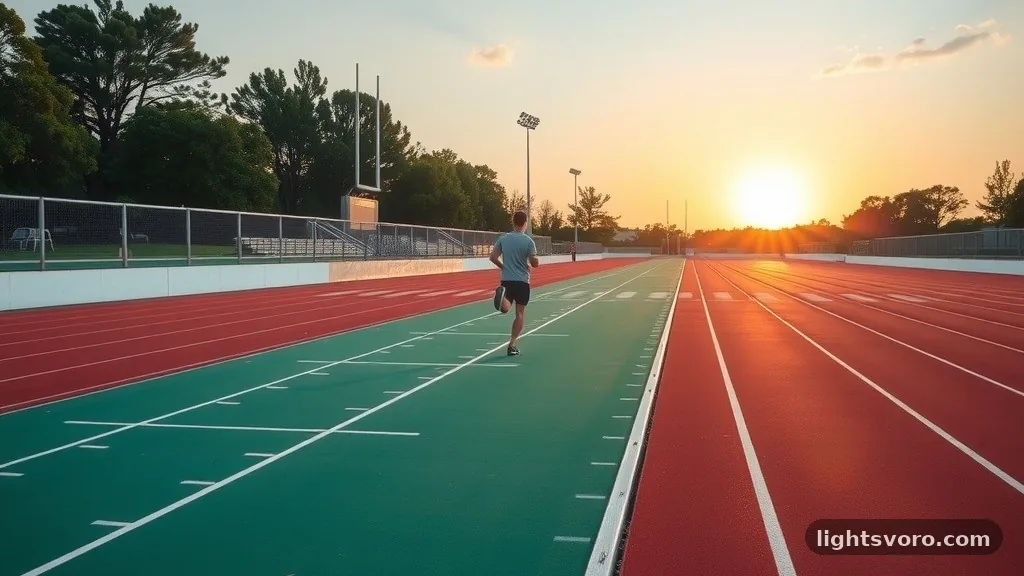
For those who spend time at local schools or community parks, the standard 400-meter running track is an excellent tool for distance estimation. A 400-meter track is approximately 1,312 feet around its entire perimeter. A single straightaway on a standard track is about 300 feet long.
To reach 500 feet, you would need to run the length of one straightaway and then continue through the curve for about half of the way around. This is a very specific, physical sensation that many people know well.
If you are standing on the starting line, you can look down the straightaway and see the 100-meter mark. 500 feet is just a bit further than the 150-meter mark on the track. This helps you visualize the distance by breaking it down into curves and straights, which are much easier to track with your eyes than a straight, featureless line.
If you are an athlete or a regular jogger, you can use your own performance data to judge distance. If you know how long it takes you to run a 400-meter lap, you can easily calculate how long it takes you to cover 500 feet, giving you a dual-check of both visual and temporal awareness.
The Reach of Common Sports Fields
Beyond football, other sports fields provide excellent reference points for 500 feet. A standard soccer pitch, for instance, can vary in size but is often around 300 to 360 feet in length.
If you take a soccer field and add another 150 feet—roughly half the length of another field—you arrive at 500 feet. This “one-and-a-half fields” rule is a simple, effective heuristic for estimating distance in large, open parks or public athletic complexes.
Baseball diamonds also offer a unique perspective. The distance from home plate to the center-field fence in many public parks is around 300 to 350 feet. If you are standing at home plate and looking toward the outfield, realize that 500 feet would be well beyond the fence, nearly into the parking lot or the surrounding trees.
This gives you a clear sense of how far a “long ball” actually travels. By using familiar sporting environments, you can quickly categorize distances as “short,” “medium,” or “long,” with 500 feet acting as the definitive “long” benchmark for most casual observers.
Visualizing Distance Through Vehicle Braking
How far does it take for a car to stop? This is a question of physics that also happens to be a great way to visualize distance.
At highway speeds (around 60 mph), the total stopping distance—including reaction time and the distance the car travels while the brakes are applied—is roughly 250 to 300 feet. Therefore, if you are driving on a highway, 500 feet is roughly twice the distance it takes to bring your car to a complete stop from highway speed.
This is a critical safety visualization. If you are following a car at a distance of 500 feet, you are giving yourself a very safe buffer. If you can visualize two car lengths of stopping distance, you have effectively visualized 500 feet.
This is particularly useful when you are driving in traffic, as it allows you to maintain a safe gap without needing to know the exact number of feet. By keeping this “two-stop” rule in your mind, you are not only sharpening your spatial estimation skills, but you are also actively improving your defensive driving habits on the road.
The Height of Famous Landmarks
Many famous landmarks can help you visualize 500 feet if you translate their height or length. For example, the Statue of Liberty, from the ground to the top of the torch, is approximately 305 feet. To reach 500 feet, you would need to stack nearly two Statues of Liberty on top of each other.
This is a powerful, iconic image that is easy to recall. If you are ever struggling to guess how far a distance is, just ask yourself if you could fit two Statues of Liberty there.
Similarly, consider the Washington Monument. While it is much taller (555 feet), it is a very common mental model for height. 500 feet is just a few dozen feet shorter than the total height of the Washington Monument.
If you look at that landmark and imagine the very tip being lopped off, you have a perfect 500-foot visual. These landmarks are ingrained in our collective consciousness, and using them as anchors allows you to perform complex spatial reasoning with very little effort. It turns abstract numbers into monumental, physical realities.
The Scale of Large Cargo Ships
If you live near a port or a large river, cargo ships are a common sight. A standard Panamax-size container ship is about 950 feet long.
If you see one of these ships, you are looking at nearly twice the distance of 500 feet. If you can imagine cutting one of those ships in half, you would have a vessel that is roughly 475 feet long, which is incredibly close to our 500-foot target.
This is a great exercise for those who live in coastal areas. When you see a ship in the harbor, try to estimate its length. Is it a massive tanker, or a smaller feeder ship?
If it looks like it is about half the length of a major cargo vessel, you are looking at a 500-foot object. This helps you calibrate your eyes for large, water-based distances, which are often the hardest to judge because there are no buildings or trees to provide a sense of scale. The water acts as a flat, featureless plane, making ships the only reliable measuring stick you have.
The Length of Commercial Trains
Trains are another excellent tool for visualizing 500 feet. A standard locomotive engine is about 60 to 70 feet long, and a typical freight car is about 50 to 60 feet long. If you stand by a railroad crossing and watch a train pass, you can estimate 500 feet by counting the cars.
Roughly 8 to 10 freight cars will equate to 500 feet of track. This is a rhythmic, counting-based method that is very easy to perform in real-time.
Next time you are stuck at a crossing, try to watch the train pass and count the cars. When you hit the 10th car, look at where the train began. That distance is your 500-foot benchmark.
This is a fun and interactive way to learn distance, and it helps you appreciate the immense length of modern transportation. It also provides a sense of scale for the noise and power of a train, as you realize that 500 feet of steel is moving past you at high velocity. This is a visceral, multi-sensory way to learn the measurement.
The Distance of Typical Airport Runways
While international airports have runways thousands of feet long, smaller regional or private airstrips often have shorter runways. A small general aviation runway might be 2,000 to 3,000 feet long, but the touchdown zone is often clearly marked in segments.
If you are ever near a small airport, look for the runway markings. These are often spaced in intervals that can help you gauge distance.
Even if you aren’t at an airport, the concept of a “runway” is a good way to visualize 500 feet. It is a long, clear, flat stretch of land. If you look at a long, straight driveway or a clear stretch of road, imagine it as a runway for a small plane.
If you think a plane could safely land on that stretch, it is likely quite long, and if it is about one-sixth of the total length of a small runway, you have found your 500 feet. This is a great way to think about large, open spaces like farm fields or industrial parks.
The Width of Large Rivers
Rivers are notoriously difficult to judge because the water moves and the banks are often irregular. However, many mid-sized rivers are roughly 500 feet wide at their narrower points.
If you are standing on a bridge, look across to the other side. If the distance feels like it would take you a minute or two to swim (if you were a very strong swimmer) or a few seconds to cross in a boat, you are likely looking at a 500-foot gap.
This is a good way to test your estimation skills. Take a photo from a bridge and later check the distance on a satellite map.
You will be surprised at how often our eyes overestimate the width of water. By training your brain to recognize 500 feet across a river, you gain the ability to judge distances in natural environments, which is essential for outdoor activities like fishing, kayaking, or hiking near riparian zones.